
 English
SAFE PLANNING AND CONDUCT OF OVERSIDE WORK
Published: 7 May 2026
Overside work includes any task carried out on or over the ship’s side, whether from the ship, the quayside, or from small boats or rafts alongside.
These tasks are often routine (for example painting, minor maintenance, arranging staging, or using bosun’s chairs) but they expose crew members to one of the most unforgiving hazards at sea: the risk of falling into water.
Industry experience shows that such events remain one of the leading causes of severe injuries and fatalities on board ships, typically happening suddenly and without warning. Environmental conditions, ship motion, shifting equipment, or even a momentary lapse in balance can turn an otherwise ordinary task into a life‑threatening emergency.
Overside work should be avoided where reasonably practicable. Where it is unavoidable, it must be approached with the same level of caution as other high‑risk activities such as enclosed‑space entry or hot work. Careful planning, full authorisation, competent personnel, clear communication, and readiness to stop work immediately if conditions deteriorate are essential parts of safe execution.
REGULATORY AND COMPANY REQUIREMENTS
Overside work is covered in the ship’s Safety Management System (SMS), where procedures will define overside work, outline when such tasks are allowed, how they must be controlled, and what authorisations are required. Central to this is the Permit‑to‑Work (PTW) system. A PTW ensures that the risks are assessed, key personnel are informed, and safeguards are put in place before the operation begins.
Where overside work is conducted alongside or involves launching boats, staging, or interaction with shore facilities, permission from terminal operators or port authorities may be required. Ship staff should confirm local port requirements in advance to ensure compliance and avoid unsafe conditions arising from conflicting operations.
The SMS usually requires that personnel carrying out overside work are properly trained, medically fit, and familiar with the fall‑prevention systems they will be using. Equipment must be certified, inspected, and suitable for the task at hand. Additionally, the bridge, engine control room, and other relevant departments must be informed so that no conflicting operations, such as but not limited to; manoeuvring; thruster use; ballast adjustments; engine movements or passing traffic, jeopardise the safety of the task.
AVOIDANCE OF OVERSIDE WORK
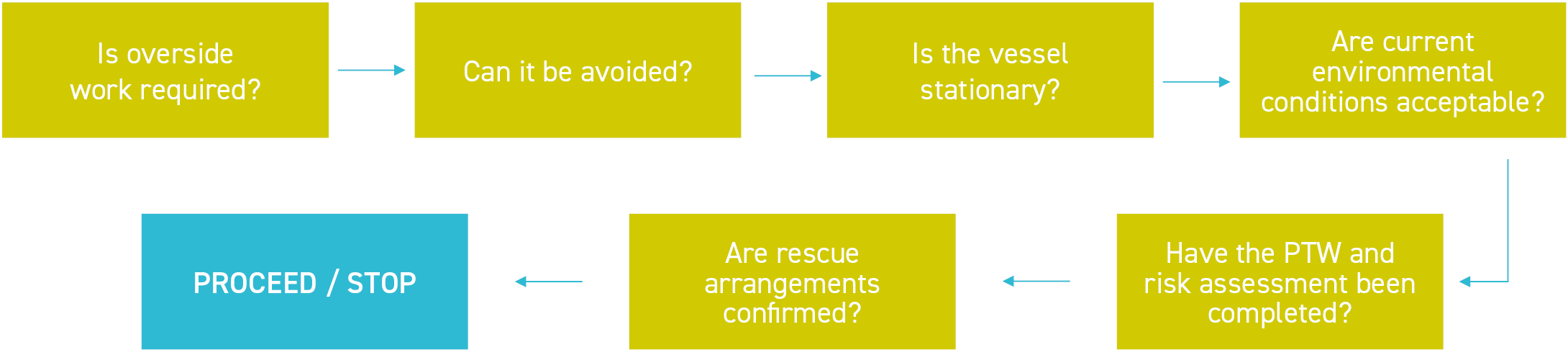
Before authorising overside work, consideration should be given to whether the task can be completed by alternative means that do not expose personnel to the risk of falling overboard.
Overside work should normally be avoided:
- When the vessel is underway
- During hours of darkness
- In restricted or congested waters
- When weather, swell, or wash from passing traffic could affect vessel movement
If overside work cannot be avoided, justification should be clearly documented in the risk assessment and Permit to Work, along with additional control measures as appropriate.
PLANNING OVERSIDE WORK
A well‑planned operation is the most effective safeguard against incidents. Planning typically begins with a risk assessment that looks not only at the work itself but at the entire environment around it. Weather and sea conditions are key determinants of whether overside work should proceed. Even light swells can cause a ship to move enough to upset a worker’s balance or set equipment swinging. Wind, glare, rain, and visibility all affect safety and should be evaluated with the same seriousness as equipment checks.
Equipment selection is another important element. All fall‑prevention equipment (harnesses, lifelines, lanyards, anchor points) must be inspected before use, confirming that they are in good condition and suitable for the specific task, e.g. bosun rigs and checks the arrangement, the officer then verifies and authorises the arrangement, and the individual worker checks their own harness.
Staging, ladders, or bosun’s chairs must be correctly rigged, tested, and secured. Radios should be checked for battery life and clarity to ensure uninterrupted communication throughout the . Personnel working overside must wear an approved lifejacket or personal flotation device (PFD) in addition to a full‑body safety harness. Buoyancy should be sufficient to account for the weight of tools or equipment being carried. Where appropriate, tool lanyards should be used to prevent dropped objects.
A toolbox talk serves as the final stage of planning. During this briefing, the entire team discusses the scope of work, expected duration, communication methods, and defined stop‑work criteria. The supervisor outlines the emergency procedure, confirms the readiness of the rescue equipment, and ensures that everyone understands their role. This conversation is often the moment when potential issues come to light, allowing the team to adjust the plan before work begins. Crew should openly raise concerns at this stage, even if it may delay the job.
CONDUCTING OVERSIDE WORK
Once the task is underway, steady communication, careful coordination, and continuous observation are key. The person working overside must always remain secured using a full‑body harness attached to a reliable anchor point. A second line or fall‑arrest device may be required depending on the task and company standard. The supervisor overseeing the work must remain attentive, monitoring both the worker and the surrounding conditions.
During overside work, the ship is exposed to forces that may not be immediately visible from deck level. Passing ships, tug activity, or pilot boat wash can all cause the ship to roll or heave unexpectedly. Even the ship’s own engines, if used for manoeuvring, can produce subtle but dangerous movement. For this reason, the bridge must maintain full awareness that overside work is in progress, and operational changes must be communicated promptly.
The overside watch plays a crucial role throughout the task. Positioned to maintain an uninterrupted view of the worker, this person acts as the first responder if anything goes wrong. They must remain focused, with rescue equipment at hand, and maintain open communication with both the supervisor and the bridge. The overside watch should not be assigned any other duties during the operation, to avoid distraction.
Overside work must not proceed unless effective rescue capability is immediately available. The designated rescue boat should not be out of service, and the assigned rescue boat crew should not be engaged in other tasks that would delay a rapid response in an emergency.
EMERGENCY PREPAREDNESS
Despite good planning and close supervision, an emergency can still arise without warning. The crew must be prepared for this possibility, and part of the planning process is to establish exactly how a rescue will be carried out. If the worker falls overboard, the man‑overboard alarm should be raised immediately. The bridge must mark the ship’s position, alert nearby traffic, and take any manoeuvres necessary to assist recovery.
Overside work should only be conducted if the crew are familiar with man overboard (MOB) procedures and recovery equipment. Regular drills help ensure that personnel can respond instinctively and effectively in an emergency.
Rescue equipment such as lifebuoys with lines, scramble nets, lifting slings, or recovery cradles must be rigged or immediately deployable. Clear communication between the overside watch, the supervising officer, and the bridge is essential to minimise response time
Recovery methods vary from ship to ship. The key principle is that the recovery method should be practical, familiar to the crew, and immediately deployable. Medical care, including oxygen and first aid, must be available once the casualty is brought back onboard, as cold shock, shock, and injury can all occur even in warm waters.
COMPLETION AND POST‑TASK REVIEW
When the work is complete, equipment should be retrieved in a controlled sequence, ensuring nothing drops into the sea or causes additional hazards. The PTW should be closed, and the area restored to normal operational status.
A short debrief adds value to future tasks. The team should discuss whether the plan worked as expected, whether any hazards appeared unexpectedly, whether the equipment performed satisfactorily, and whether the environmental conditions created any difficulties. Any equipment suspected of damage or failure must be removed from service, labelled, and reported for inspection or replacement. These observations help keep procedures relevant and ensure that future overside work continues to improve in safety and reliability.
Any lessons identified should be shared during safety meetings or incorporated into future risk assessments to strengthen onboard learning.
OVERSIDE WORK CHECKLIST
(For inclusion in SMS or as a quick reference)
BEFORE THE TASK:
- Overside work confirmed as unavoidable; alternatives considered
- Risk assessment completed
- Weather, sea state, and visibility assessed and deemed acceptable
- Port or terminal permission obtained where required
- Experienced and competent personnel to be tasked for the job
- Lifejackets / PFDs issued and checked for buoyancy suitability
- Fall‑prevention equipment inspected, fitted, and
- Staging, ladders, or bosun’s chair rigged, tested, and secured
- Rescue boat confirmed operational and crew available
- MOB recovery equipment prepared and positioned
- Bridge, engine control room, and relevant departments informed
- Overside watch assigned and briefed
- Communication devices checked, including radio tests
- Permit‑to‑Work issued and authorised
- Toolbox talk completed with all participants
DURING THE TASK:
- Worker secured at all times using approved fall‑prevention equipment
- Supervisor maintains clear oversight of the work area
- Overside watch maintains continuous visual contact with the worker
- Communication maintained without interruption
- Weather, swell, and vessel motion monitored for any changes
- Work paused or suspended if safety limits are approached
AFTER THE TASK:
- Worker and equipment recovered safely
- All equipment inspected; any defects logged
- Permit‑to‑Work formally closed
- Area restored to normal operations
- Debrief conducted; lessons documented for future reference
 BACK TO KNOWLEDGE