
 English
ENCLOSED SPACE ENTRY FOR SHORE WORKERS
Published: 25 March 2026
SHORE WORKERS REMAIN AT GREAT RISK WHEN THEIR WORK ENTAILS ENTERING ENCLOSED SPACES ON BOARD SHIPS. THEY OFTEN DO NOT FULLY UNDERSTAND THE HAZARDS THAT CAN BE PRESENT IN AN ENCLOSED SPACE, AND DUE TO THEIR LACK OF FAMILIARITY WITH THE SHIP, MAY BE UNABLE TO RECOGNISE AN ENCLOSED SPACE. FURTHERMORE, THEIR ACTIONS IN AN ENCLOSED SPACE RELATED EMERGENCY MAY PUT THEM IN GREATER DANGER.
The need to better inform and supervise shore personnel is more clearly shown in the IMO’s “Revised Recommendations for Entering Enclosed Spaces Aboard Ships”, Resolution
MSC.581(110) adopted on 27 June 2025. The recommendations emphasise education of shore workers, greater control of access to enclosed spaces, and ensuring that shore workers understand the emergency procedure when working in an enclosed space.
EDUCATE
Each situation and trade is different, and the risks vary accordingly. However, the recommendations highlight bulk carriers and general cargo ships, where shore personnel may
require access to cargo holds both for loading and discharge, as requiring particular caution.
Regardless of the nature of the ship’s trade, if it is known that visitors will be entering an enclosed space on your ship, it is recommended to open dialogue in advance. The visitor’s policy on (and knowledge of) enclosed space entry can be requested, and your company safety requirements can be shared. The
responsible person on board the ship should conduct a risk assessment of the enclosed space entries required, and depending upon the nature of the hazards identified, this may
require a joint risk assessment with the shore personnel to agree the precautions required for safe entry.
As a minimum this must include an explanation of the ship’s procedures during the familiarisation briefing, and/or ship-shore meeting. Where necessary it will be required to brief different shift supervisors. This is a relatively simple task, when there are only a few visitors that can be supervised at all times, but can be much more difficult when large numbers of personnel board at the same time, such as stevedores or dry dock workers.
ACCESS
Access control is of great importance, and much work can be done in advance of port entry to ensure that the number of access points are minimised and that the opportunity for unsupervised entry is restricted.
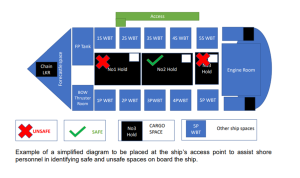
Firstly, all access points should be confirmed as clearly labelled to identify their purpose and the space they are connected to.
The relevant ship’s crew members should be briefed on the operations planned before port entry, and the spaces that are to be entered identified.
Where possible, any space that is not to be entered should be securely closed. In conjunction with ISPS requirements, the use of locking arrangements and/or seals is an effective method to
prevent unauthorised access.
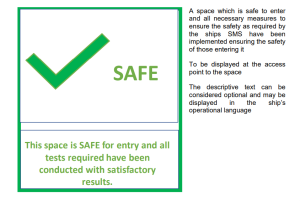
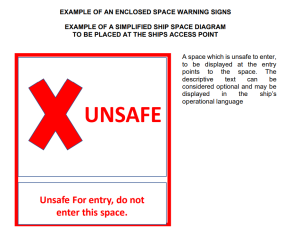
When a space is no longer safe for entry, it should be clearly demonstrated as such.
If an access is open but the space is unsafe, such as when ventilating, temporary barriers should be put in place that would require physical removal by a person to gain access.
Regular rounds should be conducted to check that activity is only occurring at the intended spaces, and no attempts have been made to open a space that is not for entry.
EMERGENCY
The shipboard emergency plan should be explained to shore personnel prior to entering an enclosed space. Of critical importance is the need for all personnel to safely vacate the space when told to, when ventilation stops, or if any personal gas detector indicates an alarm.
The need to allow only the rescue team to affect an entry must be clearly communicated. On many occasions, personnel have tried to conduct a rescue independently, invariably becoming additional casualties. Rescuing a single incapacitated person from within an enclosed space is a strenuous and dangerous task, any additional casualties reduce the speed of rescue and increase the chance of fatal injuries.
Showing that the crew are prepared to conduct a rescue, by explaining the onboard procedure, having rescue equipment prepositioned near the space entrance, and by responding quickly to an emergency will assist in preventing shore personnel from attempting their own rescue attempt.
We recommend that shipowners consult the new IMO recommendations in full and consider if their procedures for managing enclosed space entry by shore workers can be updated or improved accordingly.
PERSONNEL MUST NOT BE ALLOWED TO ENTER AN ENCLOSED SPACE UNTIL THEY HAVE BEEN MADE AWARE OF:
- The location and limits of the spaces they are permitted to enter: best practice is to escort the personnel to the designated space
- How to identify an enclosed space on the ship: for example the simple schematic suggested in the guidelines
- Explain the enclosed space entry procedure on board: the need for an entry permit for each space to be entered, and the atmosphere testing requirements
- The current status of the space to be entered: where possible, it is useful to demonstrate the atmosphere testing with the shore personnel witnessing
- How to tell if an enclosed space is safe for entry: such as the simple signage provided in the guidelines
- Danger signs when working in an enclosed space: for example feeling lightheaded, fatigued, or nauseous
- The onboard emergency procedure for enclosed space rescue.
 BACK TO KNOWLEDGE