
 English
CRUSH HAZARDS AT SEA: SAFE HANDLING OF HEAVY STEEL PLATES
Published: 13 January 2026
In a case handled by the Club, three crew members were moving 10 pieces of steel plate around the steering gear room while the ship was underway. Each piece measured approximately 2.4m x 1.2m and 5mm thick, weighing around 110kg.

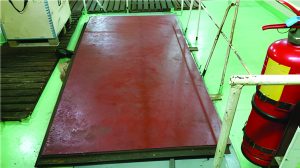
After transferring the plates to their new location, two crew members were holding the plates against adjacent railings, while another crew member was trying to secure the plates to the railings using a rope. The ship rolled unexpectedly due to large swell which resulted in the plates moving and falling on top of the crew member who was attempting to secure them with a rope, partially crushing him as he tried to escape. The injured person (IP) was fortunate that the other crewmembers were there to help remove the plates which had fallen on to him. However, he did suffer very serious leg, arm, and internal injuries.
The ship was diverted so that the IP could receive emergency medical treatment, and he spent six weeks in hospital before his condition stabilised sufficiently to allow repatriation home to continue medical treatment there.
The investigation after the incident revealed that whilst a risk assessment and toolbox talk had been carried out, they were found to have been done improperly. During the risk assessment process, the risk of personal injury was identified as highly likely and therefore the task should not have been carried out without suitable mitigation measures being in place. For example, any work task that relies solely upon the strength of the personnel involved is not always safe.
It was also found that the toolbox talk was treated as a tick box exercise only; the risks were not discussed, and the job was not adequately supervised as per the work plan.
To prevent such incidents in future the following actions are recommended:
- The risk assessment should be fit for purpose, the control methods used to reduce the likely hood of the risk should be clear for everyone involved
- During the toolbox talk the risks and actions must be discussed thoroughly with the people involved
- The crew should be encouraged to challenge and contribute during risk assessment and toolbox talks
- Whenever possible, the correct lifting equipment (such as chain blocks and cranes) should be used
- The crew must be encouraged to use the ‘stop and think’ approach if things do not go according to plan
- If the procedures are not effective, they should be reviewed and changed
- Lessons learnt should be shared with the fleet
However, there was a more fundamental problem; the location and arrangement chosen to store these steel plates were inappropriate.
Steel plates are deceptively heavy, and when stowed vertically have a very small surface area to balance upon. Any movement, such as the unpredictable motion of a ship in a seaway, can send them rapidly falling towards deck, only stopping if a sufficiently strong obstacle is encountered.
It is widely acknowledged that for safety reasons, steel plates should be laid flat and stowed horizontally. Where space does not allow this preferred method, they should be stowed in a purpose-made rack of sufficient strength that allows removal of one plate at a time without having to remove the securing arrangement of all.
Unfortunately, too often, steel plates are stowed upright, against a handrail, or secured by a piece of rope. This is very dangerous and there are many examples within the shipping industry of personnel being killed or severely injured due to falling steel plates when a person tries to remove them from the stowed position.
We would encourage you to examine your situation on board, do you have steel plates stowed in an unacceptable manner, could the arrangement be made safer?
 BACK TO KNOWLEDGE